


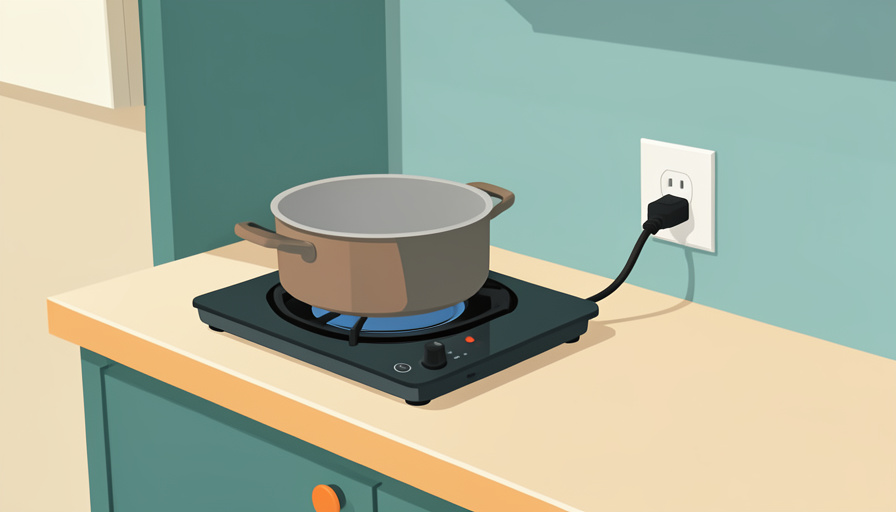
Nine plug-in cooking setups that give renters real induction-style cooking without touching the wiring, and the outlet and cookware facts behind each.
Renters rarely get to install a proper cooktop, and a hardwired induction range needs a 240V circuit no landlord is rushing to add. The workaround is a plug-in option that lives on the counter and moves out with you. But not every unit behaves the same on a standard outlet, and induction has one rule that catches people off guard: it only works with magnetic cookware. These induction cooktop alternatives for renters cover the full range, from a $75 mini burner to a four-zone countertop range, with the power and pan requirements spelled out so you buy the right one.
At a Glance
For most renters, a single-burner portable induction unit is the sweet spot: cheap, fast, and it runs on any standard outlet. Step up to a double burner or a four-zone countertop range if you cook full meals, but watch the wattage, since two 1800W zones can overload one circuit. If your pots are aluminum or glass, skip induction and choose an infrared or coil burner instead, or add a converter disk. The one number that governs all of it is amps: an 1800W unit pulls about 15, which is a whole standard circuit.
| Option | Best for | Cookware | Power / outlet |
|---|---|---|---|
| Single-burner induction | Most renters | Magnetic only | 1800W, standard 15A outlet |
| Mini induction (IKEA Tillreda) | Tight budgets | Magnetic only | ~1200-1800W, standard outlet |
| Double-burner induction | Cooking full meals | Magnetic only | High draw, may need two circuits |
| 4-zone countertop range | Closest to a real cooktop | Magnetic only | Pick a 120V model, check amps |
| Infrared / ceramic burner | Non-magnetic cookware | Any cookware | ~1800W, standard outlet |
| Electric coil hot plate | Lowest cost | Any cookware | Lower wattage, standard outlet |
| Converter disk | Keeping old pans | Enables any on induction | Used with an induction unit |
| Induction + air-fryer combo | Tiny counters | Magnetic only | Standard outlet |
| Low-wattage travel induction | Weak/shared circuits | Magnetic only | ~1000-1300W, gentle on amps |
Table of Contents
1. A single-burner portable induction cooktop


Best for: almost every renter who wants fast, precise cooking without installation.
This is the default answer, and for good reason. A workhorse like the Duxtop 9600LS runs about $117, delivers 1800 watts on a standard 120V outlet, and gives you 20 power levels for real control. Induction heats fast and stays cool around the pan, which is safer and more comfortable in a small kitchen. The one catch is power draw: at full blast it pulls roughly 15 amps, essentially a whole circuit, so do not run it alongside a microwave on the same outlet.
- Pros: Fast, precise, energy-efficient, cool surface, fully portable.
- Cons: Magnetic cookware only; one unit can nearly max out a circuit.
2. A budget mini induction burner

Best for: the cheapest possible way into induction, or a dorm and studio.
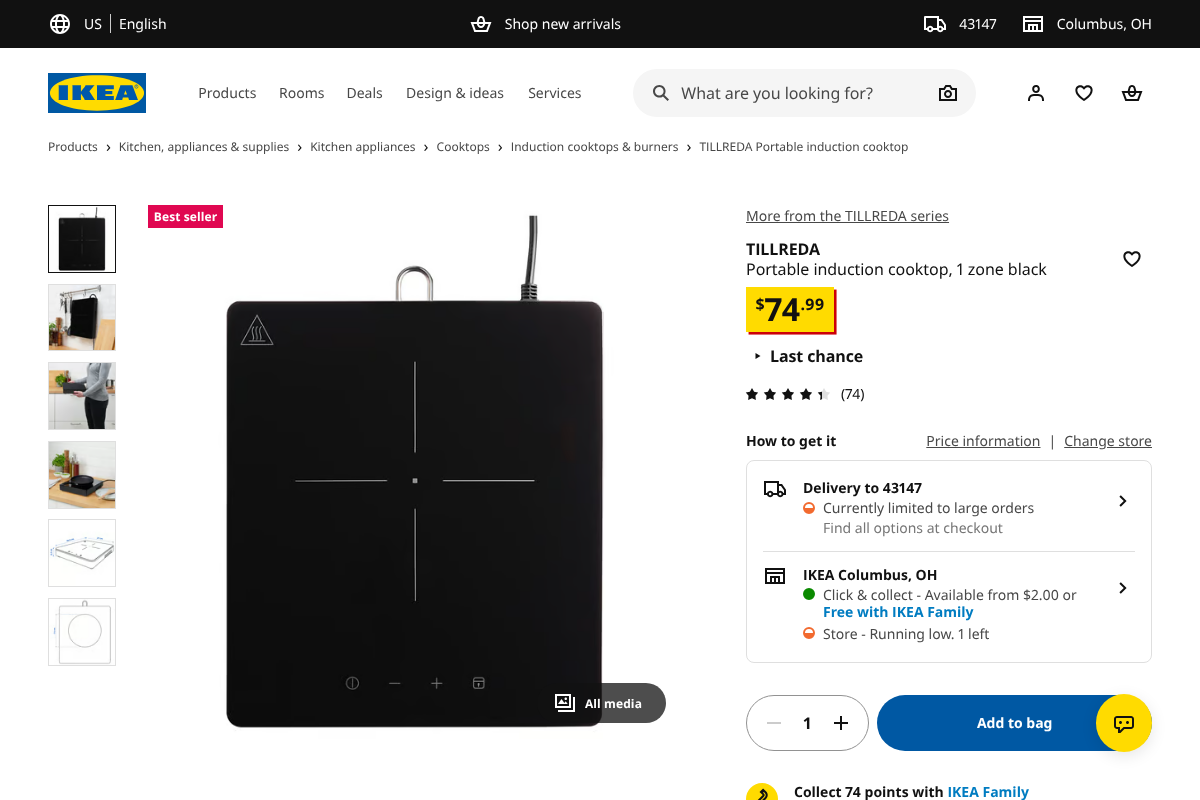
If money is tight, a mini burner like the IKEA TILLREDA gets you cooking for around $75. It is a single small zone, easy to stash in a cupboard, and highly rated by buyers for what it is. Do not expect the fine control or top-end power of a pricier unit, and check stock, since budget models cycle in and out. For one person heating a pan of pasta or eggs, it is plenty.
- Pros: Very affordable, compact, stows away easily.
- Cons: One small zone, basic controls, availability comes and goes.
3. A double-burner portable induction
Best for: renters who cook full meals and need two pans going at once.
A two-zone unit lets you simmer a sauce while searing, which a single burner cannot. The trap is electrical: two full-power induction zones can draw far more than one standard 15-amp circuit allows, so many units either cap the combined wattage or expect you to plug the two zones into outlets on different circuits. Before buying, read how the unit manages power and check whether your kitchen outlets share a breaker, or you will trip it mid-dinner.
- Pros: Two pans at once, closer to a real stovetop.
- Cons: Can overload a single circuit; larger counter footprint.
4. A four-zone countertop induction range


Best for: the closest thing to a built-in cooktop without construction.
Freestanding countertop ranges with three or four zones exist and sit on the counter like an oversized appliance. They are the nearest match to a real cooktop, but power is the deciding factor: some are 120V plug-in units, while higher-output models need a 240V outlet, which defeats the no-wiring goal. For a rental, specifically choose a 120V model and confirm its total amperage fits your circuit. It is the priciest route here, so it only makes sense if you cook seriously.
- Pros: Multiple zones, cooktop-like experience, still removable.
- Cons: Expensive, bulky, and some models quietly require 240V.
5. An infrared or ceramic countertop burner


Best for: renters whose pots are aluminum, copper, or glass.
Here is the honest fix for induction’s biggest limitation. Induction only heats magnetic, ferrous cookware, so your favorite aluminum or glass pans simply will not work on it. An infrared or ceramic countertop burner heats the surface directly, which means it works with any cookware you already own. It runs slower to heat and the surface stays hot after cooking, but it saves you from rebuying an entire pan set just to switch cooktops.
- Pros: Works with any cookware, no special pans needed, plug-and-play.
- Cons: Slower heat-up, hot surface after use, less precise than induction.
6. An electric coil hot plate
Best for: the lowest cost and total cookware freedom.
The humble coil hot plate is the cheapest entry of all, often well under $40, and like infrared it works with any cookware. It is slower and less precise, and the exposed coil gets very hot, but it is dead simple and often draws less than a full 1800 watts, which makes it gentler on a weak circuit. For occasional cooking or a backup burner, it is hard to beat on price.
- Pros: Cheapest option, any cookware, often lower power draw.
- Cons: Slow, imprecise, exposed hot element.
7. An induction converter disk
Best for: keeping your non-magnetic pans while still using induction.
This one is a clever accessory rather than an appliance. An induction interface disk is a flat metal plate you set on an induction burner; the burner heats the disk, and the disk heats your non-magnetic pot on top. It is less efficient than cooking directly on induction and adds a piece to wash, but it lets you pair an induction unit with the glass or aluminum cookware you already own, bridging the one gap that stops many renters from going induction.
- Pros: Cheap, lets any pot work on induction, keeps your cookware.
- Cons: Slower and less efficient, an extra item to store and clean.
8. An induction and air-fryer combo
Best for: the smallest kitchens, where counter space is the real constraint.
If your counter is the size of a cutting board, a combo unit that pairs an induction burner with an air fryer or multi-cooker earns its footprint by doing two jobs. You get a cooktop and an oven-style appliance in one plug, which is ideal for studios. The trade-off is that combo units can be jack-of-all-trades, so check that each function is actually good rather than merely present, before you rely on it for daily cooking.
- Pros: Two appliances in one footprint, one outlet, great for studios.
- Cons: Individual functions may be weaker than standalone units.
9. A low-wattage travel induction unit
Best for: old apartments with weak or shared circuits.
If your building’s wiring is ancient and an 1800W burner keeps tripping the breaker, a lower-wattage travel or RV-style induction unit, often rated around 1000 to 1300 watts, is the fix. It cooks a little slower but is far less likely to overload a fragile circuit or a shared outlet. For renters who have fought their breaker box and lost, dialing down the wattage is smarter than fighting it.
- Pros: Gentle on weak circuits, compact, travel-friendly.
- Cons: Slower cooking, still magnetic cookware only.
How We Chose These
We picked options that require zero installation and run on what a rental already has, then sorted them by the two things that actually decide fit for renters: how much power they pull on a standard circuit, and whether they demand magnetic cookware. We included non-induction burners and a converter disk precisely because induction’s cookware rule is the most common dealbreaker, and a good renter guide has to solve that, not ignore it.
The Bottom Line
For most renters, a single-burner portable induction cooktop is the right call: fast, safe, and it runs anywhere. Move to a double burner or countertop range only if you cook full meals, and mind the amps, because two 1800W zones will fight one circuit. If your cookware is not magnetic, an infrared burner or a converter disk saves you from rebuying pans, and a coil plate wins on pure price. Match the wattage to your outlet, match the burner to your pots, and you get real cooking with nothing bolted to the wall. For more home guidance, see YouGottaRead’s look at what appliance warranties cover and the Home & Garden section.
Frequently Asked Questions
What is the best induction cooktop alternative for renters?
A single-burner portable induction cooktop suits most renters, offering fast, precise cooking on any standard outlet with no installation. If budget is the priority, a mini unit like the IKEA TILLREDA works for around $75. If your cookware is not magnetic, choose an infrared burner or add a converter disk instead.
Can I run a portable induction cooktop on a normal outlet?
Yes. Most portable induction units run on a standard 120V outlet, but an 1800W model draws about 15 amps, which is nearly a full circuit. Avoid running it on the same outlet or breaker as another high-draw appliance like a microwave, or you may trip the breaker.
Why won’t my pans work on an induction cooktop?
Induction only heats magnetic, ferrous cookware, so aluminum, copper, and glass pans will not work. Test a pan by seeing if a magnet sticks firmly to the bottom. If your cookware is not magnetic, use an infrared or coil burner, or place an induction converter disk between the burner and the pan.
Do double-burner induction units overload a circuit?
They can. Two full-power induction zones can draw more than a single 15-amp circuit allows, so many units cap the combined wattage or expect the two zones on different circuits. Check how the unit manages power and whether your kitchen outlets share a breaker before buying one.
Are portable induction cooktops safe to leave on a counter?
Yes, they are designed for countertop use and stay cool around the pan, which makes them safer than open coils. Still, give the unit ventilation space, avoid trapping the fan vents, and unplug it when not in use, as you would any high-wattage appliance.


