


Here is a modern travel nightmare that has nothing to do with lost luggage. You land in a smaller town, try to log into your bank or email, and it wants the code it just texted you. Except the text is not there. Two bars, then one, then a spinning nothing, while the login screen counts down. If you are on a budget carrier and this keeps happening away from home, you start wondering whether the plan is the problem. That is exactly the itch these Mint Mobile alternatives for reliable SMS 2FA are meant to scratch.
To be fair to Mint Mobile, it is a well-liked, genuinely cheap plan, and for a lot of people it is plenty. The catch is structural, not a defect: Mint is an MVNO that runs on one host network, so its coverage and text delivery are only as good as that network wherever you happen to be standing. When you travel into an area where that network is weak, or gets congested, your two-factor codes can lag. This guide lays out solid alternatives, honest about the trade-offs, plus the part nobody tells you, which is that switching carriers may not even be the real fix.
The Short Version
If your priority is 2FA texts that show up reliably wherever you travel in the US, the most dependable route is a postpaid plan on a network that is strong along your routes, since postpaid customers are not deprioritized the way budget MVNO customers can be during congestion. Verizon and AT&T lead for broad and rural coverage, T-Mobile is strong in many areas and keeps you on familiar towers with postpaid priority, and value options like Visible, US Mobile, and Google Fi give you strong networks or network choice at a lower price. Just know that an authenticator app can sidestep SMS entirely.
Why SMS 2FA Fails While Traveling, and Whether Switching Even Helps
Before you port your number anywhere, it is worth understanding the mechanism, because it changes what the right fix is.
A text-message 2FA code has to travel over a cellular network to reach you, so its reliability depends on two things: whether you have real coverage where you physically are, and whether your plan gets priority when the network is busy. Mint Mobile runs on T-Mobile’s network, so in a spot where T-Mobile is thin, Mint is thin too, brand aside. And because budget MVNO plans can be deprioritized behind the host network’s own postpaid customers during congestion, a packed area can slow your texts even when bars look fine. That is the honest reason a different plan can help: not because Mint is bad, but because a postpaid plan on a network that is strong on your route removes both weak points.
Here is the part that saves some people a switch entirely. Text codes are the least reliable form of two-factor, and you can often stop depending on them. An authenticator app generates codes on your phone with no signal needed, and passkeys skip codes altogether, both working over Wi-Fi or fully offline. Turning on Wi-Fi calling can also let texts arrive over Wi-Fi when cellular is weak. So the real answer is sometimes a better carrier, and sometimes just moving your logins off SMS. We cover the lockout side of that in our guide to eSIM transfers and 2FA lockouts.
How We Chose These Alternatives
This is a roundup built around one job, reliable codes on the road, so the criteria reflect that:
- Coverage where people actually travel. We favored networks with broad nationwide reach, including rural areas where budget plans tend to struggle, described in plain terms rather than invented percentages.
- Priority and deliverability. Postpaid plans that are not deprioritized get an honest edge for time-sensitive texts, and we flag where a pick is an MVNO that can be slowed during congestion.
- Currently real in 2026. Every pick is an operating US carrier or brand you can sign up for now, verified against its own current pages.
- Travel-friendly setup. eSIM support and, for some, the ability to pick or switch networks make life easier when you move around.
- A spread of budgets and fits. The list runs from premium coverage to value plans, so there is a match whether you want maximum reliability or a cheaper step up from Mint.
We checked each carrier’s official current plan or coverage pages to confirm it is operating and which network it uses, and kept every coverage claim qualitative rather than citing a made-up figure.
Mint Mobile Alternatives at a Glance (2026)
| Carrier | Network | Plan type | Best for |
|---|---|---|---|
| Verizon | Verizon (own) | Postpaid | Widest coverage, including rural |
| AT&T | AT&T (own) | Postpaid | Broad nationwide coverage |
| T-Mobile | T-Mobile (own) | Postpaid | Same towers as Mint, with priority |
| Visible | Verizon | Prepaid (eSIM) | Verizon coverage on a budget |
| US Mobile | Verizon, T-Mobile, or AT&T | Prepaid (MVNO) | Choosing or mixing networks |
| Google Fi | T-Mobile plus Wi-Fi | Prepaid (MVNO) | Automatic network and Wi-Fi switching |
1. Verizon: The Widest Coverage for Rural Travel
If your trips take you off the interstate and into rural areas, a Verizon postpaid plan is the most reliable answer for codes that show up. Verizon runs its own network with broad nationwide reach that is especially strong away from big cities, and as a postpaid customer you are not deprioritized behind budget plans when a tower is busy. For someone whose whole complaint is texts failing in smaller towns, this is the direct fix.
Who it is for: Travelers who regularly hit rural or remote areas and want the highest odds of a code arriving on time.
Honest cons: It is one of the pricier options, a clear jump from Mint’s budget rates, and you are paying for coverage you may not need if you mostly stay in well-served cities. You can compare current options on Verizon’s unlimited plans page.
2. AT&T: A Broad Nationwide Second Opinion
AT&T is the other heavyweight for wide coverage, and it is worth checking against Verizon based on where you actually travel, since the strongest network genuinely varies by region and route. AT&T runs its own network with strong nationwide and rural reach, and a postpaid plan again means your texts are not deprioritized during congestion. Coverage leadership is local, so the best way to choose between the two majors is to look at their maps for the places you go.
Who it is for: People who want top-tier coverage and find AT&T is stronger than the alternatives on their common routes.
Honest cons: Like Verizon, it sits at the premium end of pricing, and it is overkill if your travels stay within areas every network already covers well. Check AT&T’s current wireless plans and coverage map on its official site before switching.
3. T-Mobile: Same Towers as Mint, but With Priority
Here is a subtle but useful option. Mint runs on T-Mobile’s network, so if your coverage is usually fine and the failures happen mainly in busy places, moving to a T-Mobile postpaid plan keeps you on the same towers you already use while removing the MVNO deprioritization that can slow codes when the network is congested. You stay in familiar coverage and gain priority.
Who it is for: Current Mint users whose coverage is generally okay but who see codes stall in crowded areas like events, airports, or downtowns.
Honest cons: If your problem is rural dead zones rather than congestion, staying on the same underlying network may not help much, since T-Mobile’s rural reach, while improving, has historically trailed Verizon and AT&T in some regions. It also costs more than Mint. Review T-Mobile’s current plans and coverage map on its official site.
4. Visible: Verizon Coverage at a Prepaid Price
Visible is a Verizon-owned, digital-first brand that runs on Verizon’s network, which makes it an appealing middle ground: much of Verizon’s coverage strength for a price closer to Mint’s world. It leans into eSIM and app-based setup, which is convenient when you are activating on the go, and its unlimited plans are simple.
Who it is for: Budget-minded travelers who want Verizon-level coverage and easy eSIM activation without a premium postpaid bill.
Honest cons: As a Verizon-owned prepaid brand, it can be deprioritized behind Verizon’s postpaid customers during congestion, so it improves your coverage footprint more than your priority. Support is digital-only, with no stores to walk into. See current plans on the Visible plans page.
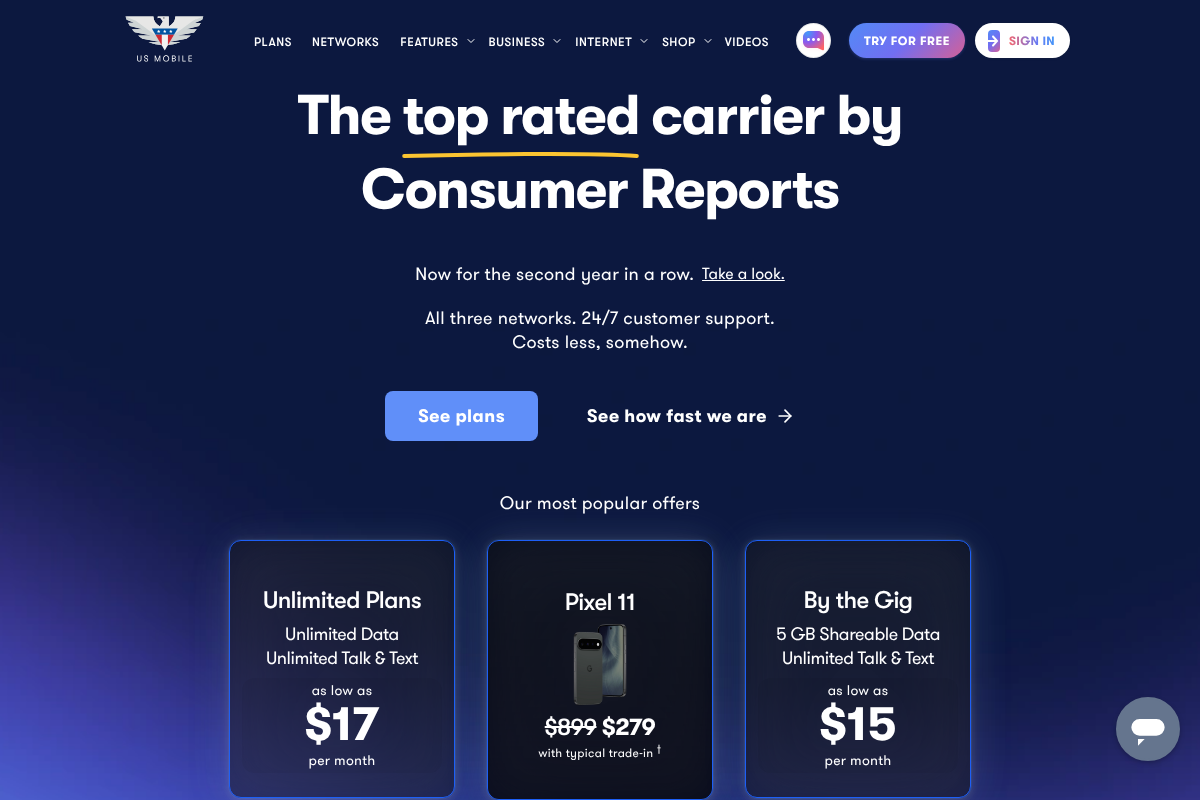
5. US Mobile: Pick, or Mix, the Best Network for Your Route
US Mobile is the flexible pick, because it offers service on all three major networks and lets you choose which one you want, or run more than one. For a traveler, that is powerful: you can match the strongest network to the places you go, or keep a second line on a different network as a backup for exactly the moments a code will not arrive. It is a current, well-regarded MVNO with eSIM support.
Who it is for: Travelers who want to tailor their network to their routes, or carry a dual-SIM backup so a weak signal on one network is covered by another.
Honest cons: As an MVNO, its plans can be deprioritized on whichever network you pick during congestion, and the choose-your-network flexibility means a little more setup and self-service than a plain postpaid plan. Explore networks and plans at US Mobile.

6. Google Fi: Let the Phone Pick the Best Signal
Google Fi is built around switching, moving between its network and Wi-Fi to find you a usable connection, which suits people who move around a lot. For 2FA texts, the appeal is that the phone tries to keep you connected through Wi-Fi calling and network handoff rather than leaving you stranded on one weak signal. It supports eSIM and is straightforward to run on a compatible phone.
Who it is for: Travelers who want a hands-off setup that leans on Wi-Fi and automatic switching to keep codes flowing.
Honest cons: It is still an MVNO-style service, so it can be deprioritized during congestion, and depending on your usage its pricing may not beat a comparable prepaid plan. Its biggest coverage strength is tied to its primary host network, so check that network against your routes. Review Google Fi’s current plans on its official site.
This article is general information, not carrier, security, or professional advice, and coverage, plan details, network priority, and pricing vary by location, plan, and time and change often. Coverage claims here are qualitative, and you should confirm real-world coverage for your specific routes on each carrier’s official maps. For anything security-sensitive, prefer an authenticator app or passkeys over SMS where offered, and verify current plan terms with the carrier before switching.
Frequently Asked Questions
What are the best Mint Mobile alternatives for reliable SMS 2FA while traveling?
For the most reliable text codes on the road, a postpaid plan on a strong network is the safest bet, with Verizon and AT&T leading for broad and rural coverage and T-Mobile strong in many areas while keeping you on the same towers Mint uses, now with postpaid priority. If you want to spend less, Visible offers Verizon coverage at a prepaid price, US Mobile lets you choose or mix the major networks, and Google Fi leans on automatic network and Wi-Fi switching. Match the network to where you actually travel.
Is Mint Mobile bad for two-factor text codes?
No, Mint is a solid, low-cost plan for many users, but it has a structural trade-off. It runs on T-Mobile’s network as an MVNO, so its coverage matches T-Mobile wherever you are, and budget MVNO plans can be deprioritized behind the host network’s postpaid customers when the network is busy. That combination is why codes can lag when you travel into weaker or crowded areas. It is a coverage and priority issue, not a flaw in the service itself, and it is the same trade-off any budget MVNO carries.
Will switching carriers actually fix delayed 2FA texts?
Often, yes, if the new carrier has genuinely better coverage or priority where you travel, since delivery depends on real signal and whether your plan is deprioritized during congestion. But not always, and sometimes the better fix is to stop relying on SMS. An authenticator app makes codes on your phone with no signal needed, passkeys skip codes entirely, and Wi-Fi calling can carry texts over Wi-Fi in weak spots. Try moving critical logins off SMS first, then switch carriers if coverage on your routes is the real problem.
Do postpaid plans really get texts faster than budget MVNOs?
During network congestion they can, because postpaid customers on a network’s own plans are generally not deprioritized, while budget MVNO plans may be slowed when a tower is busy. For a time-sensitive login code in a crowded place, that priority can be the difference between a code arriving now or after the timer runs out. In areas that are not congested, both usually deliver fine, so the advantage matters most in busy locations and at peak times rather than everywhere.
Is an eSIM or a second line worth it for reliable 2FA on trips?
It can be, especially if you travel often to places one network covers poorly. An eSIM makes it easy to add a plan on a different network without swapping physical cards, and a service like US Mobile can put you on the strongest network for your route or let you run two networks at once. Keeping a second line on a different carrier as a backup means that when one network cannot deliver a code, the other likely can. For frequent travelers, that redundancy is often worth the modest extra cost.
The Bottom Line
The honest takeaway on Mint Mobile alternatives for reliable SMS 2FA is that Mint is not the villain, its single-network, budget-MVNO design just shows its limits when you travel somewhere its network is weak or busy. If reliability on the road is your priority, a postpaid plan on Verizon, AT&T, or T-Mobile removes the deprioritization and, for the first two, widens rural coverage, while Visible, US Mobile, and Google Fi offer strong-network or network-choice value for less. And before you switch at all, consider moving critical logins to an authenticator app so a weak signal never holds your account hostage. For more, see our guide to choosing a carrier for reliable 2FA texts and our explainer on eSIM transfers and 2FA lockouts, or browse the YouGottaRead Tech section.


